I build AI systems that turn ideas into playable, watchable, shippable things.
My work sits where generative media, multiplayer games, multi-agent software, and privacy-preserving data systems meet. This page is the short version: active platforms, a live game, and a case study in making sensitive legacy data safer to evaluate and release.
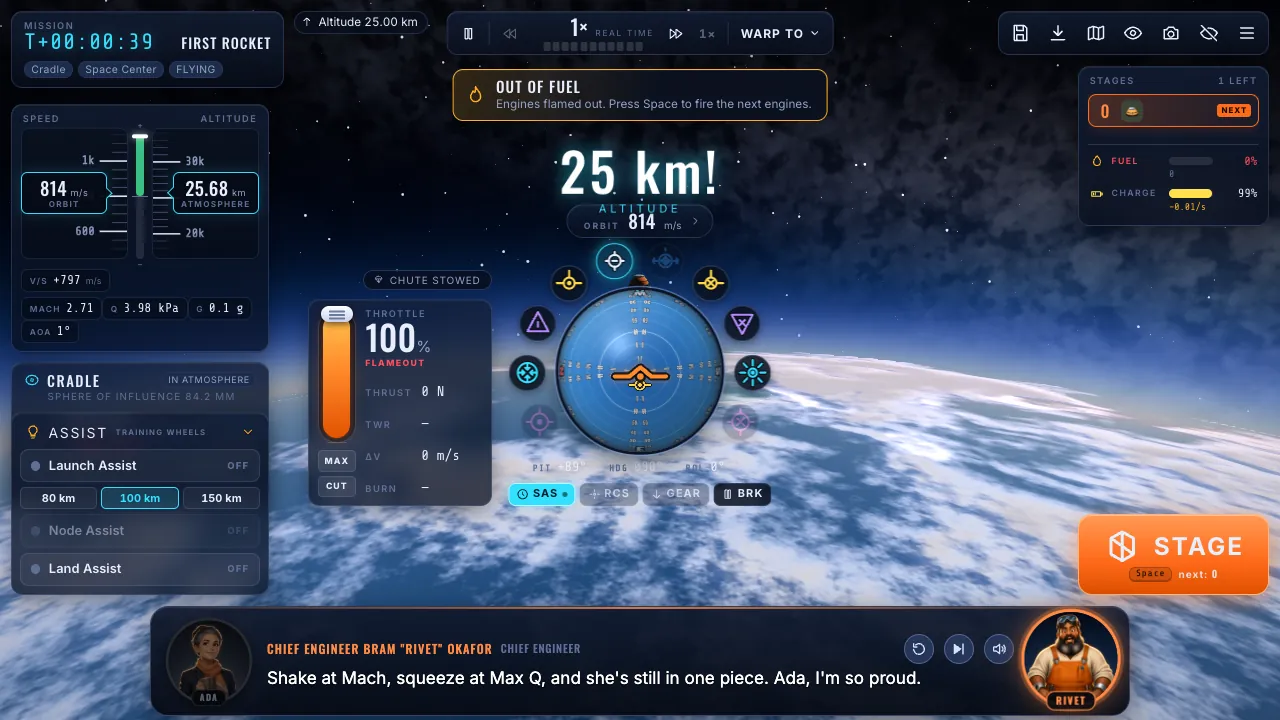
A rocket-building and space-flight sandbox with real physics and a friendly start. Two voiced, bantering instructors, Ada and Rivet, teach you to build, launch and land as you fly. Single player, no account, no ads, and it runs on desktop, tablet and phone.
Fast Rocket, in-game screenshot from the browser build.
In development · voice command
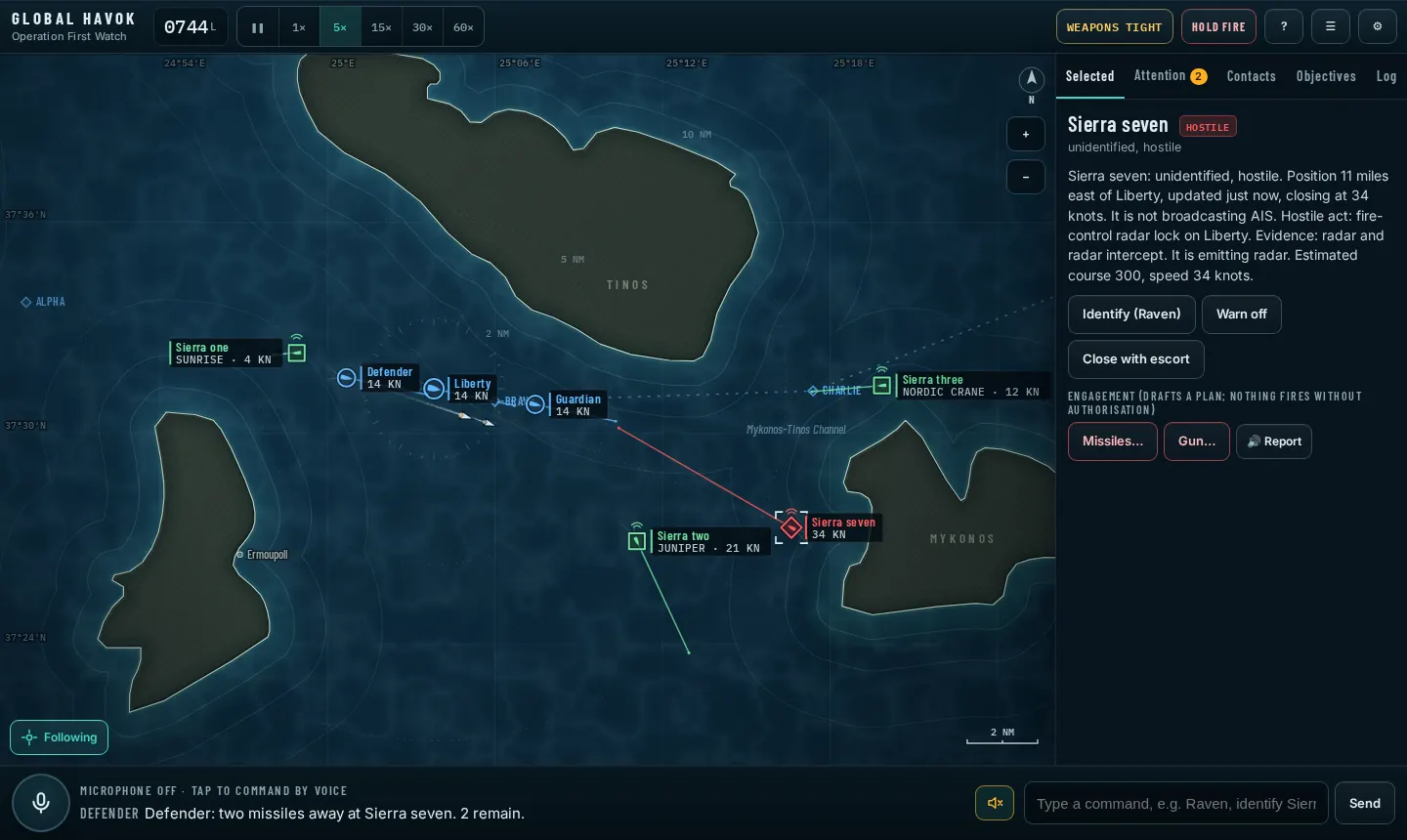
BattleOps: command a naval task group by voice.
Say it. Hear it read back. Then it happens.
An experiment in spoken command. Speech recognition (Moonshine tiny, about 31 MB) runs entirely on your device in WebAssembly, so nothing you say leaves it. A rule grammar turns the words into orders, and weapons only fire after a readback and a confirmation by name. Ship names and taught phrases were picked by a test rig that speaks thousands of synthetic commands into the recognizer. Three operations, playable by voice, touch or mouse.
BattleOps, in-game screenshot from the browser build.
AI video studio
uncen.ai
Uncen turns a single prompt into short-form clips, long-form videos, music videos, narrated stories, scenes, voice, images, and assembled edits. It is the media engine underneath the rest of my work: workers coordinate the messy pipeline so creators can stay at the level of intent.
Prompt-to-video workflows for short and long form projects
AI images, voices, music, scenes, and editing/assembly tools
Worker orchestration designed for real production pipelines
Multiplayers.ai is built around a sharp thesis: vibe coding games should be multiplayer-first. Its games can leverage uncen.ai for images, audio, music, video, and world-building assets, then use swiftest.ai-style agents to design, critique, and iterate faster.
Generate, remix, copy, and publish browser games
Designed for multiplayer and shareable live demos from day one
Powered by uncen.ai media generation for art, sound, music, and richer worlds
Guided by smarter, faster, better agents inspired by swiftest.ai
Swiftest.ai is my many-minds concept: a way to make AI work feel more like a team of specialized thinkers than a single chat box. The goal is better judgment, stronger iteration, and software that can carry complicated work across multiple perspectives.
Multi-agent reasoning, critique, and synthesis
Tools for evaluating ideas from several specialized angles
A product direction for faster, more thoughtful building
I make games to test my own tools under real load. Below is how they are built and why, not just what they are.
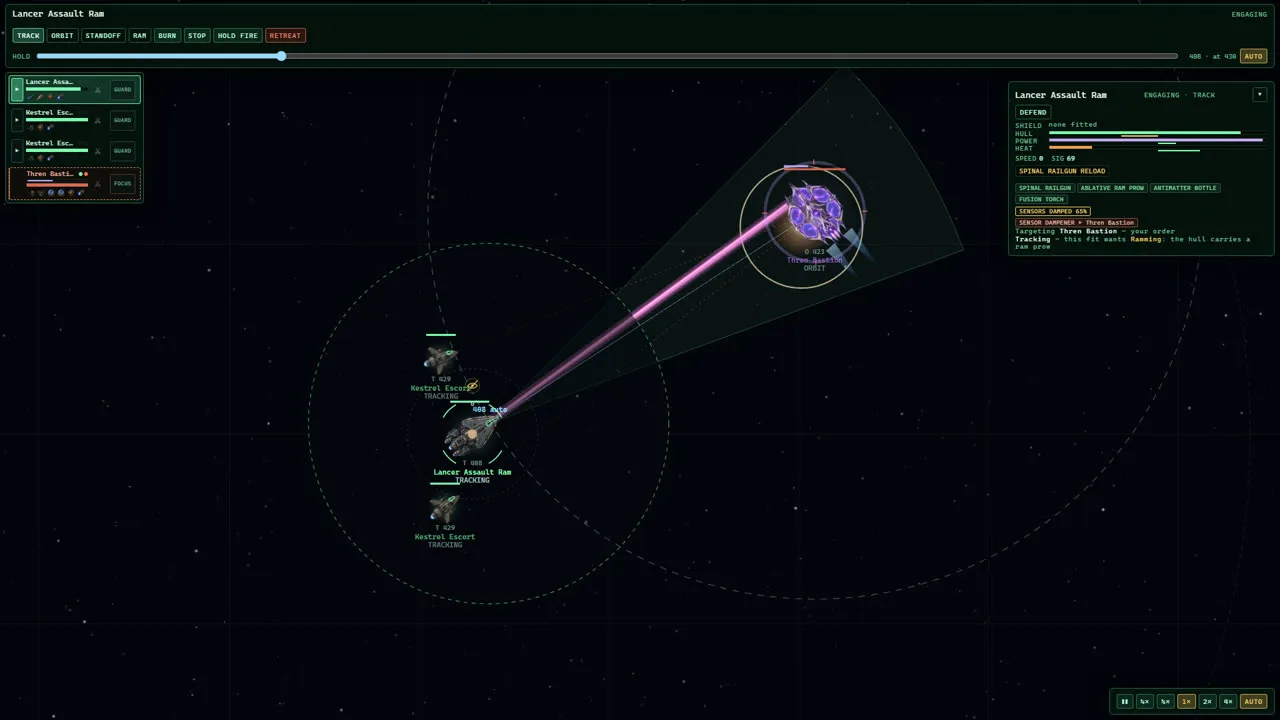
Humanity: First Year, in-game screenshot from the browser build.
Case study · architecture
Humanity: First Year: An HFY Story
A short-session, real-time 2D space expedition in the spirit of Weird Worlds. HFY is the genre where humans are the underdog: here, railguns, warheads and drone swarms against alien shields built to stop energy, not mass. About 84,000 lines of TypeScript.
Simulation core kept apart from rendering. A seeded RNG with independent named streams, so adding one new random roll does not shift every later encounter or loot draw, and its state saves with the game.
A typed event bus: the simulation emits; rendering, audio and the story director only listen and queue commands. They never change world state directly.
Content as data: hulls, modules, items, factions and encounters are definitions checked against TypeScript types and gathered in one content database.
A real-time combat simulation. Every pointer action, mouse or touch, goes through one hit-test function, so a rule like "a cloaked ship cannot be selected" is written once.
One static web build for phone, tablet and PC, wrapped for Android with Capacitor.
The rules are kept simple enough to read at a glance, and the scope was cut so a beta could ship.
Outfitting: any module fits any slot, one of each type. Guns are limited by mount points.
Combat stays real time. The player can drop to half or quarter speed, and the game slows itself when one of your ships is in trouble. It only ever slows the clock, never speeds it up.
Scope cut for the beta: one location per star system and one main story line. The rest is saved for a second game.
Assets come from YAML manifests run through the uncen CLI (Asset Yard). Lock files record each batch: 1,875 voice lines, 38 music tracks, 29 sound effects and about 145 images.
First commit to build 135 in about two weeks, across 453 commits. Code written with Claude Code under my direction; design, tuning and tests are mine.
Earlier: Dangerous, a 3D open-world space combat RPG I shipped as Binary Helix on iOS, Android and Amazon in 2011–12 and on Steam in 2014. Version 2.6.1 returned to Google Play in 2026.
Playable demo
Rocket Boots, embedded from Multiplayers.ai.
This is the first version of the embeddable game widget idea: a live Multiplayers game running inside another webpage, with the same platform direction of AI-generated media from uncen.ai and agent-assisted iteration from swiftest.ai.
Portable embed
For the platform, this can become a generated widget snippet on every published game page.
Music is part of the same practice for me: mood, pacing, structure, memory. These tracks sit next to the platforms because the worlds need sound as much as software.
Privacy and AI data safety
Data preparation that treats privacy as an engineering system.
Alongside creative AI and backend platforms, I design privacy-preserving pipelines for large legacy datasets. The work combines code-grounded visibility analysis, deterministic redaction, NER-assisted review, sensitive-content quarantine, media risk screening, and explicit release gates.
The case study below is based on internal DDN archive work. It is an engineering record, not a legal clearance opinion, and it does not expose row-level data.
Lineage and detection
Code-grounded lineage
Trace actual application visibility and access flags, validate schemas and joins, and distinguish content that is merely stored from content that is actually eligible for review.
Public versus private visibility semantics
Join and orphan-integrity checks
Direct-identifier and markup screening
Residual risk
Review before release
Automated detection is treated as a review signal, not as privacy clearance. Conservative NER and language signals feed a high-recall quarantine for sensitive or ambiguous material, with human validation gates.
Person, place, health, minor, and media-risk signals
Multilingual limitations documented
No buyer delivery until release gates pass
Evidence and governance
Aggregate-only release receipts
Reproducible runbooks, hashes, counts, and policy manifests make it possible to show what was checked without publishing source records, contact details, or row-level samples.
Approximately 8.96M posts and 9.79M postdata rows checked
Approximately 6.64M chat rows and 739,680 image rows profiled
247,220 forum records in strict internal validation